A little more clearance necessary here.
Saturday, April 19, 2014
Tri-Y Headers, 6-speed
While doing the pan modification , I had a 302 block and heads hung from my gantry-like fixture that holds the motor in place while I figure out how to make things fit. So I decided to try the ebay Tri-Y headers that I got a while back. That worked out pretty well, so the next obvious thing was the T56 mounted to a Quicktime adapter that I've had for a while.
A little more clearance necessary here.
Friday, April 4, 2014
Modified Ford 302 oil pan
The Ford 302 has a front oil pump that interferes with the placement of the motor in a Miata. The front sump of the oil pan is one of the limits as to how far back and how low in the car the engine can be placed. So, it's common to modify the pan for optimal placement. These pics show the beginning of the process, marking the pan for subsequent cuts. This essentially duplicates what I did when I installed the 302 in my BRG several years ago, but since I didn't take good pictures at the time, I'm taking this opportunity to document the process.
The idea is to place a vertical wall at the rear of the oil pump as close as possible to the pump body. It can actually touch; there is no relative movement, but that's poor form, so a little clearance is suggested. Then the placement of the horizontal floor is determined by the internal rotating assembly, pretty much by turning the crank so the connecting rod bolts (nuts) are at their closest point to the pan and allowing some clearance. This is a moving part so some clearance is required. Maybe 1/8" or so. I fit the pan very close with no gasket, the gasket thickness then determines the clearance.
The modification only needs to be in the area of about 2" or so behind the oil pump, as the only interference is the very top and front edges of the round steering rack tube.
Saturday, February 15, 2014
Tubular Subframe with Ford 302
This is actually the prototype of a tubular subframe I put together. It ended up being used in a 2002 SE Miata with a slightly modified 302 and T5 transmission.
Installing in car showing relationships of motor mounts. The mounts were offset towards the passenger side to allow for maximum clearance at the steering shaft. These headers are Ford Motorsports/Patriot 8427 1 5/8 tubes, but this approach may work with others as well.
Friday, February 14, 2014
Five Lug Conversion
These pics are from a few years back when I first did this on my '91 BRG. The object of this exercise is to convert the Miata from 4-lug hubs to 5-lug with the 5X4.5" (5X114.3) bolt pattern. I used RX-7 hubs on the front, Mustang Cobra hubs on the rear. Later, I used re-drilled Tbird hubs on the rear.
91 spindle on left, then RX7 for strut type suspension, then RX7 for swing arm IFS.
Modified spindle with spacer and RX7 5-lug hub.
Then the hub. Spacer is shorter than inner race of bearing so full clamp load is on the bearing. The spacer essentially floats. Slip fit on shaft, slip fit on bearing.
Modification consists of cutting the original diameter down .200" into the base.
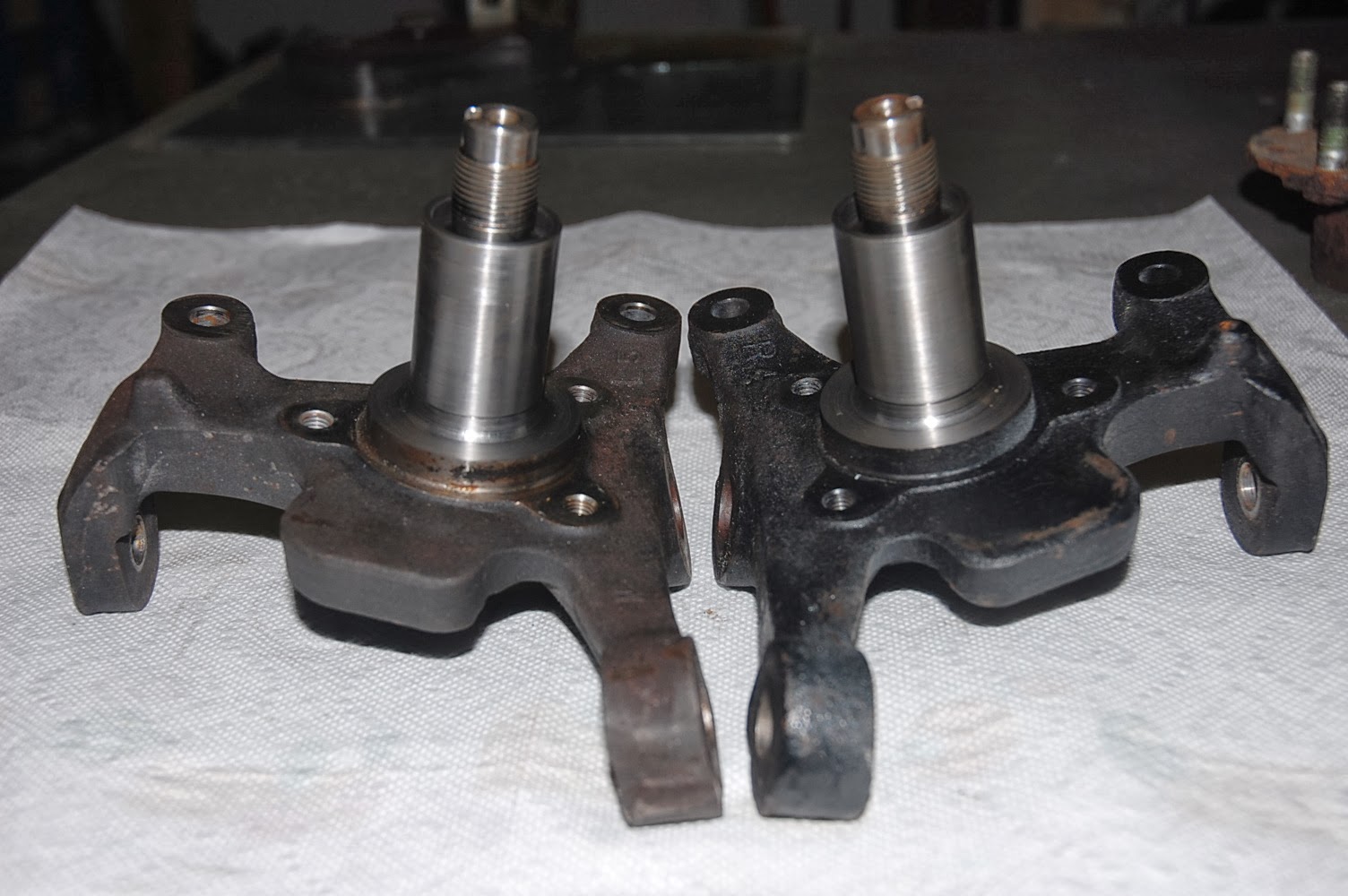
Modified Miata on left, stock Miata on right.
Left and right side Miata spindles modified with spacers. Note the diameter at the base of the spindles, same as the OD of the spacer, which fits the ID of the bearing. Slip fit, not a press fit anywhere.
Spacer dimensions: ID=1.101", OD=1.298", Length=1.764"
Dimension from top of installed sleeve to base=2.00"
Dimension from top of shaft to base=3.00"

Same idea, the spacer is shorter than the inner race, so the races are clamped by the nut, the spacer floats.

Stock Miata 4-bolt front hub on left, RX-7 front/Probe rear hub on right


When I did my '91 in 2007, the Cobra IRS hubs were available for $50.00 ea. As of Feb 2014, they were in the range of $150-180. So it seems reasonable to redrill Tbird hubs. However, the 2002-08 Explorer has an IRS design using some of the same components as the old Tbird/Mustang Cobra IRS, so the hubs may work in this application. I haven't tried it yet. A quick search on Rockauto shows the Explorer hub with bearing for $38.00. If it works, that would be the way to go.
The following pics show modification of T-bird rear hubs to get the 5 X 4.5" pattern. The stock T-bird has 5 X 4.25". Also snout diameter is reduced to that of the Miata so this hub now fits into the stock Miata upright/bearing, and has the Ford splines which work with the Factory Five Roadster axles.
Drilling was done on a milling machine with the hub held centered in a rotary table. My approach was to center on one of the stock holes with a probe in the drill chuck, with a line thru that hole and the center hole perpendicular to the x axis of the machine. Then rotate 36 degrees, offset .125" and drill. Rotate 72 degrees, drill, etc. Center drill, then 5/16" pilot drill, then 37/64" drill, then 19/32" ream.

The Miata and Tbird hub bearing snouts are virtually the same length. I measured 4 of each and the average dimension was the same for both at 1.424" long. The variation was less than .005". Some may have been pressed out of the bearing with the "socket and hammer" approach.
I measured the diameter of the Miata hub at 1.574", the Tbird at 1.654". So the mod consists of cutting the diameter of the Tbird hub down to 1.574" with the appropriate radius at the base to mitigate stress fractures.


91 spindle on left, then RX7 for strut type suspension, then RX7 for swing arm IFS.
RX7 is considerably larger but uses same design for bearings, just a little bigger. About .200" longer and .200" larger diameter. Calls for a spacer and slight modification of the Miata spindle.
Modified spindle with spacer and RX7 5-lug hub.
Spindle with spacer installed
Following pics are from 2014, did another set. Pretty much the same, slight difference in that the cut on the Miata spindle base was to the diameter of the Rx7, rather than the Miata. I figured there may be a slight strength advantage to having the larger diameter of the RX7 at the base.
Spacer dimensions: ID=1.101", OD=1.298", Length=1.764"
Dimension from top of installed sleeve to base=2.00"
Dimension from top of shaft to base=3.00"
Stock Miata 4-bolt front hub on left, RX-7 front/Probe rear hub on right
When I did my '91 in 2007, the Cobra IRS hubs were available for $50.00 ea. As of Feb 2014, they were in the range of $150-180. So it seems reasonable to redrill Tbird hubs. However, the 2002-08 Explorer has an IRS design using some of the same components as the old Tbird/Mustang Cobra IRS, so the hubs may work in this application. I haven't tried it yet. A quick search on Rockauto shows the Explorer hub with bearing for $38.00. If it works, that would be the way to go.
The following pics show modification of T-bird rear hubs to get the 5 X 4.5" pattern. The stock T-bird has 5 X 4.25". Also snout diameter is reduced to that of the Miata so this hub now fits into the stock Miata upright/bearing, and has the Ford splines which work with the Factory Five Roadster axles.
Drilling was done on a milling machine with the hub held centered in a rotary table. My approach was to center on one of the stock holes with a probe in the drill chuck, with a line thru that hole and the center hole perpendicular to the x axis of the machine. Then rotate 36 degrees, offset .125" and drill. Rotate 72 degrees, drill, etc. Center drill, then 5/16" pilot drill, then 37/64" drill, then 19/32" ream.
The Miata and Tbird hub bearing snouts are virtually the same length. I measured 4 of each and the average dimension was the same for both at 1.424" long. The variation was less than .005". Some may have been pressed out of the bearing with the "socket and hammer" approach.
I measured the diameter of the Miata hub at 1.574", the Tbird at 1.654". So the mod consists of cutting the diameter of the Tbird hub down to 1.574" with the appropriate radius at the base to mitigate stress fractures.
Subscribe to:
Posts (Atom)